

Network fundamentals

This is a section of the chapter "Internet" of the book “Principles of Digital Multimedia”.
The text introduces computer networks as systems of autonomous, connected devices capable of exchanging information.

Computer networks (or computer network, or simply network) indicates a set of autonomous computers connected by a single technology. 
Two computers are said to be connected when they are able to exchange information.
Internet It is the most famous example of computer networks, in fact it is a network that connects all the computers in the world..
A host It is any device connected to a network.
Database

A fundamental element in networks are the database.
A database is a structured set of information (or data) usually stored electronically in a computer system.
Databases are essential to the Internet because they allow you to reliably store, organize, and quickly retrieve huge amounts of data: user profiles, posts, products, payments, messages, reservations, logs, permissions.
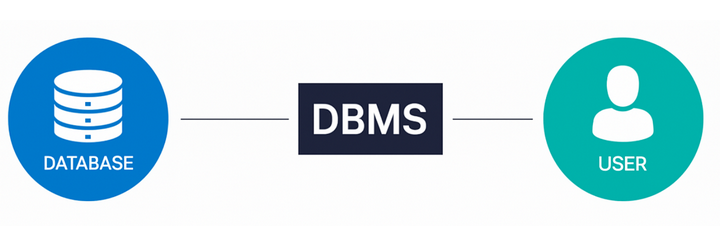
The database is controlled by software DBMS, Database Management System (database management system).
Data within databases is generally presented in rows and columns contained in a series of tables.
A table is made up of fields, the columns, and record, the lines.
A field is an attribute of data, whereas a record is a specific piece of data.
When you enter data, you insert a record into the table.

Example
Below is a student table where:
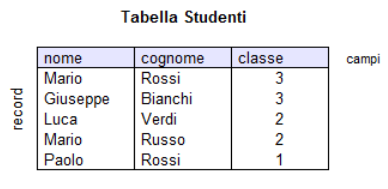
  • Each field is an attribute of the record.
  • Each record is a student.

A query It is a user request that requests a specific set of records from the database using selection criteria.

Example
A query could be, for example, to fetch all student records that have the class attribute value 3.

The data contained in the database can be easily viewed, managed, modified, updated, checked, added, deleted and organized.
Most databases use the language SQL, Structured Query Language, to write data to tables and run queries.

Example
Imagine having a bookstore management application where you need to keep track of books, authors, and customers. In this case, a database could be used to organize and store all the relevant information.

Database structure:

  • “Books” table
    Fields: ID, Title, Author, Publication Year, Genre, ISBN, Available Quantity.
  • “Authors” table
    Fields: ID, First Name, Last Name, Date of Birth, Nationality.
  • “Customers” table
    Fields: ID, First Name, Last Name, Email, Phone Number, Registration Date.
  • “Loans” Table
    Fields: ID, Book ID, Customer ID, Loan Date, Expected Return Date.

Example of use:
Suppose a new customer, Marco, registers at the bookstore and wants to borrow J.R.R. Tolkien's "The Lord of the Rings." Here's how the application would use the database:

  • The application checks whether the book “The Lord of the Rings” is available by checking the available quantity in the “Books” table.
  • After confirming that the book is available, the application creates a new record in the “Loans” table with Marco’s information, the book, and the loan date.
  • The available quantity of the book is updated by subtracting one, since a copy has been borrowed.
  • If Marco returns the book by the expected return date, the application updates the record in the “Loans” table with the actual return date.
  • Meanwhile, if the application receives new books to catalog, they will be inserted into the “Books” table and the corresponding authors into the “Authors” table.
  • If a customer forgets to return a book by the due date, the app can set a notification to remind the customer to return the book on time.
  • The application can generate reports using database information, such as displaying which books are currently on loan, which books are most popular based on loans, a list of authors in the library, and so on.

The application checks whether the book “The Lord of the Rings” is available by checking the available quantity in the “Books” table.
After confirming that the book is available, the application creates a new record in the “Loans” table with Marco’s information, the book, and the loan date.
The available quantity of the book is updated by subtracting one, since a copy has been borrowed.
If Marco returns the book by the expected return date, the application updates the record in the “Loans” table with the actual return date.
Meanwhile, if the application receives new books to catalog, they will be inserted into the “Books” table and the corresponding authors into the “Authors” table.
If a customer forgets to return a book by the due date, the app can set a notification to remind the customer to return the book on time.
The application can generate reports using database information, such as displaying which books are currently on loan, which books are most popular based on loans, a list of authors in the library, and so on.

In this example, the database plays a key role in organizing and managing information about the bookstore's books, authors, and customers, simplifying the process of borrowing and returning books, and providing tools for analyzing data about the bookstore's business.

Packet

The data that circulates on the network has a format called packet.
The packet is divided into two sections:
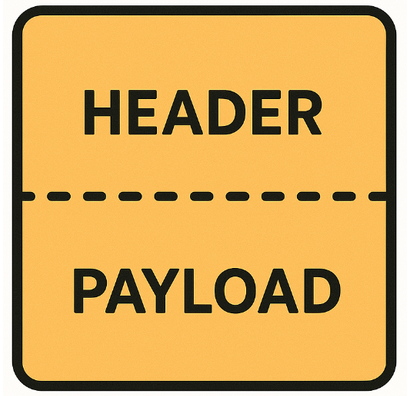
  • Header : contains various information, including the sender and recipient addresses for routing the packet across the network. Essentially, it contains all the meta-information needed to send the packet (e.g., if you send an email, part of the header is the recipient's address).
  • Payload : indicates the actual portion of the transmitted data that is intended for the user (e.g. if you send an email, the payload is the text of the email).

Want to help me write articles like this?

Leave a Reply

Your email address will not be published. Required fields are marked *

No responses yet

Support the project

All the materials I share are born from a very simple belief: good training shouldn't just teach you which buttons to push, but help you understand the ideas, principles, and processes behind the tools.
That's why I dedicate a significant portion of my time to studying, organizing, and producing free content dedicated to multimedia, design, and visual communication. Articles, lessons, insights, and resources aim to make topics often addressed in a fragmented or superficial way accessible.
This work, however, requires time, research, and care. Every guide, every video, every material published for free is the result of many hours of study, writing, and editing.
Supporting the project through Patreon allows me to continue producing quality educational content, keep it accessible to as many people as possible, and dedicate more energy to building a resource that can be useful to students, professionals, and enthusiasts.
If you believe a deeper, more rigorous, and informed understanding of multimedia is valuable, your contribution not only supports my work: it helps make these resources available to the entire community.
Thank you for your support and trust.

Is Patreon too demanding?

You can also support me with a free donation, without a subscription and without obligation.
Even a small contribution helps me continue to create free games, educational content, and materials with more freedom.