

A distributed system It is a computing model in which multiple components collaborate with each other to perform a task or provide a single service.
In a distributed system, hardware and software resources are distributed across multiple computers interconnected within a network.
The main goal of a distributed system is to efficiently exploit available resources, improving the scalability, reliability, and availability of the overall system.
The key feature of a distributed system is the transparency, that is, the quality that users and developers should perceive the system as a coherent entity, regardless of the physical distribution of resources.
In a distributed system, the existence of multiple computers is invisible to the user, who has the impression of dealing with a single computing system.
A middleware It is a software that acts as an intermediary between applications or software components within a distributed system: it is thanks to the middleware that the user perceives transparency
Indeed, its main purpose is to facilitate communication, management, and interaction between different parts of a system, especially when these parts may reside on different parts of a network.
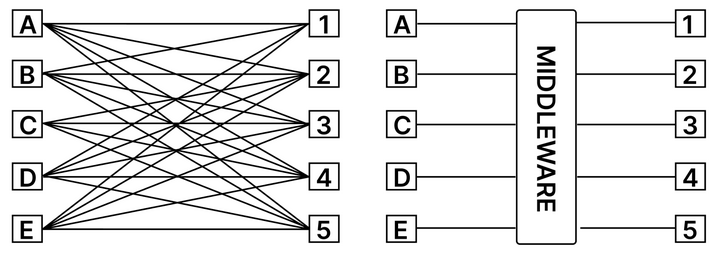
So, ultimately, the definition of a distributed system is:
A distributed system is a network of computers managed by middleware that facilitates consistency and collaboration between the different parts, thus contributing to a more efficient and coordinated functioning of the system as a whole.
Example
Spotify is a music streaming service that allows users to listen to music online from a vast catalog of songs.
This service is provided through a distributed architecture since the songs are distributed across servers around the world, but the user is unaware and perceives that he is communicating with a single entity.
Cloud
A technology that makes extensive use of the distributed system is the cloud.
Until recently, IT services were only local (think of Photoshop you downloaded to your computer; it works locally and doesn't need an Internet connection).
With the evolution of the network, which has become much faster and more secure, IT services are moving from local software to web services: that is, users have a user interface for the application via their web browser, but the real work is done by the server, which only sends the result to be displayed to the interface.
This change in mentality has the advantage of not having to load the application onto their device, but letting a server do everything, which is probably a more powerful machine than their device.
The concept that refers to the use of IT services over the network is called cloud computing, which goes beyond the simple presence of resources on the Internet and involves accessing and using virtual resources as services.
These services may include data storage, data processing, application deployment, data analysis, and much more.
So:
The term "cloud" generically refers to computing resources that run cloud computing. Computing resources include servers, storage devices, networks, and services, which are hosted on the Internet in a data center, rather than on local devices or servers. Therefore:
The cloud represents a set of hardware and software resources that run cloud computing.
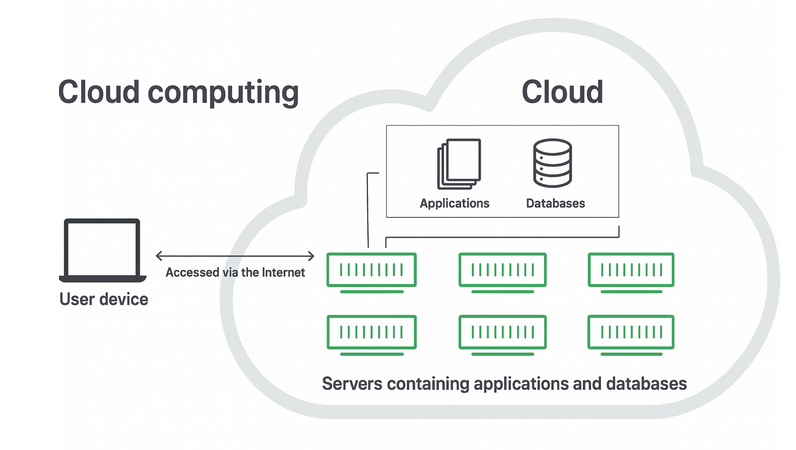
The cloud allows users to access the same files and applications from virtually any device because the processing and storage take place on servers in data centers, rather than locally on the user's device.
This is why a user can log into their Instagram account using a new phone after the old one breaks and still find the account there, with all the photos, videos, and conversation history.
Example
Google Drive is considered a cloud system for several reasons:
Database structure:
For businesses, moving to cloud computing removes some IT costs and overhead: for example, they no longer have to update and maintain their own servers, as the cloud service provider they use will do this.
This is especially significant for small businesses, which may not be able to have their own in-house infrastructure but can cost-effectively outsource infrastructure needs through the cloud.
The cloud can also make it easier for businesses to operate internationally, because employees and customers can access the same files and applications wherever they are, as long as they have a web connection.
Of course, the cloud is a distributed system because the user using the cloud does not have the perception that they are communicating with a remote server but rather that everything is running locally.
Want to help me write articles like this?

No responses yet