


This lesson introduces the concepts of network protocols and layered architecture, explaining them as a set of rules that enables different devices and software to communicate effectively.
The text illustrates how protocols define message formats, the order of exchange, error handling, and interoperability between different systems. It then explains the organization of networks into layers, where each layer provides services to the layer above it and communicates with the corresponding layer on the other device.
The lesson also presents the Internet’s layered architecture—application, transport, network, link, and physical—and introduces the concept of encapsulation: the process by which each layer adds its own header to the data received from the layer above.
Network protocols
A network protocol is a set of rules that establishes how two or more devices must communicate with one another. These rules define the format of messages, the order in which they are exchanged, and the behavior to follow when errors occur or responses are missing (International Telecommunication Union [ITU], 1994; Kurose & Ross, 2026).
A communication protocol can be defined as a set of rules established to enable correct communication. For example, two people with different native languages might agree to use English to communicate.
In particular, a protocol defines the language formed by the exchanged messages, which must be interpreted correctly (ITU, 1994).
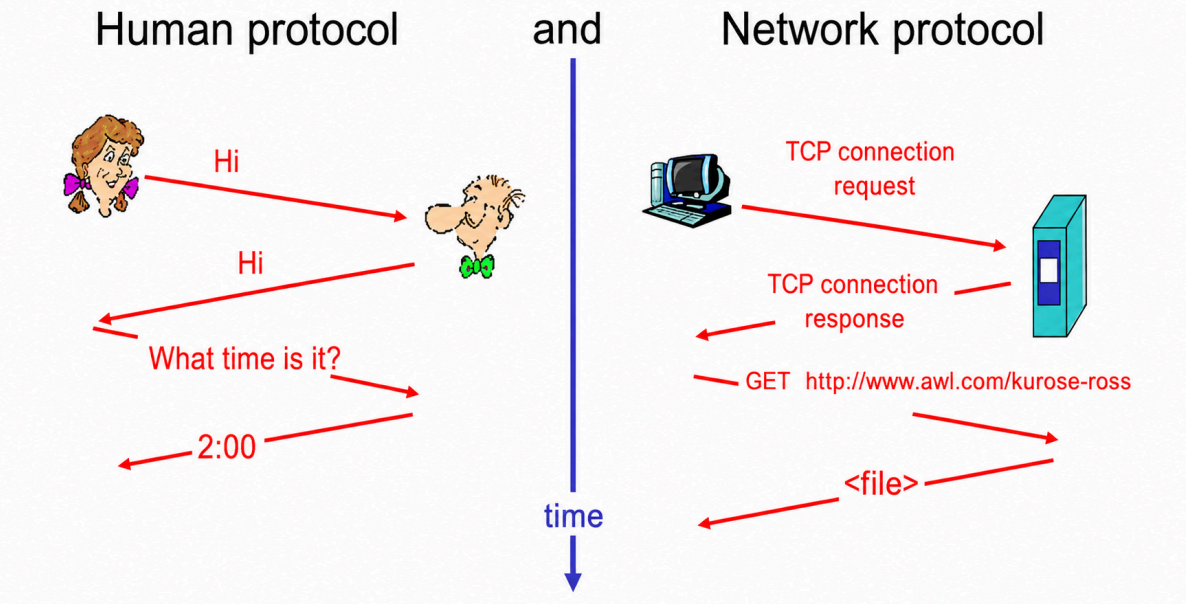
Following protocols ensures that two software programs running on different machines can communicate effectively, even if they were developed independently. In other words, protocols ensure interoperability (Braden, 1989; Carpenter, 1996).
Interoperability is the ability of a computer system or product to cooperate and exchange information or services with other systems or products (Braden, 1989).
The purpose of interoperability is therefore to facilitate interaction between different systems.
The implementation of network protocols within a network architecture forms what is known as network software, which is implemented through both software and hardware: the operating system, network drivers, applications, and, for certain tasks, the network interface card (Braden, 1989).
To reduce complexity, most networks are organized into a protocol stack made up of layers built on top of one another (ITU, 1994; Kurose & Ross, 2026).
Each layer provides services to the layer above it and hides the technical details of how those services are implemented (ITU, 1994).
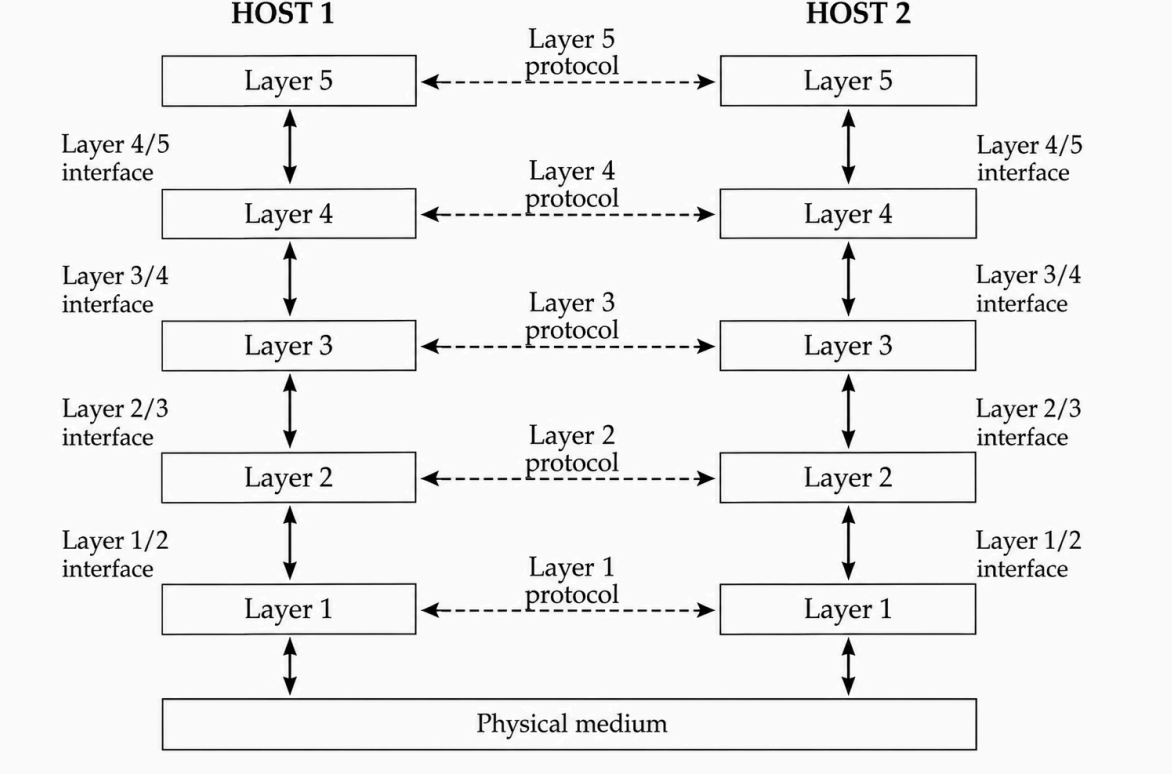
When layer n in one computer communicates with layer n in another computer, the rules and conventions used in this communication are collectively known as the protocols of that layer (ITU, 1994).
The entities belonging to corresponding layers on different computers are called peers (ITU, 1994).
In other words, peers communicate with one another by using a protocol (ITU, 1994).
If layer n of one computer needs to communicate with layer n of another computer, the sender passes the information down to layer n−1 and continues until it reaches the lowest layer, usually the physical layer, where the information is actually transmitted. At the receiver, the information then moves progressively up through the layers until it reaches layer n (ITU, 1994).
The complete set of layers and protocols is called a network architecture (ITU, 1994).
Example
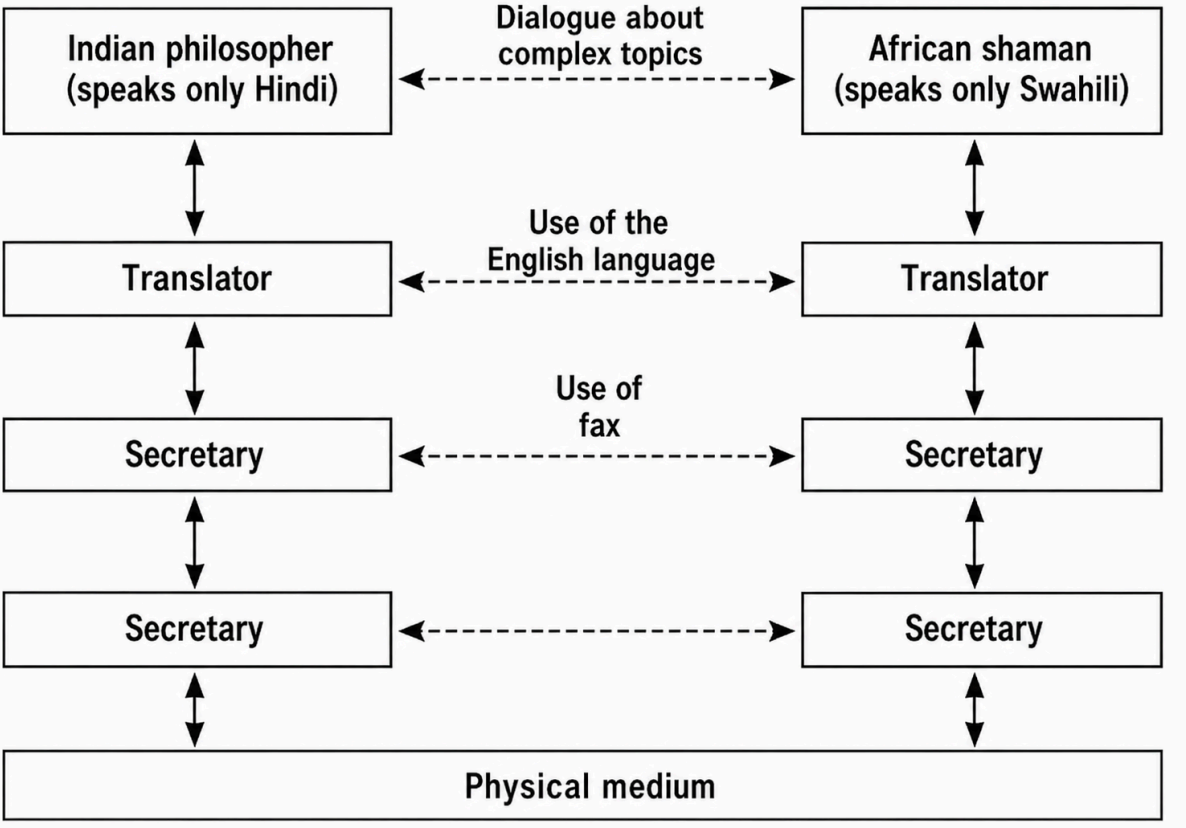
To understand the basic mechanisms of a network architecture, consider the following analogy: an Indian philosopher wants to speak with an African philosopher, but the two do not speak the same language.
Each philosopher therefore relies on a translator, and the two translators agree to use English as a common language.
Each translator, in turn, gives the text to a secretary, and the two secretaries agree to transmit it by fax.
Communication therefore takes place as follows: the Indian philosopher expresses an idea to the translator; the translator converts it into English and passes it to the secretary; the secretary sends it by fax.
At the other end, the secretary receives the fax and gives it to the translator, who translates the text from English into the African philosopher’s language and delivers it.
Each layer ideally communicates with its peer: the philosophers exchange ideas, the translators exchange texts in English, and the secretaries exchange faxes. In reality,
however, no layer communicates directly with its counterpart at the other end. Each layer passes the message to the layer below it until physical transmission occurs at the lowest layer.
Communication could not take place without an agreement between the peers at each layer: English between the translators and fax transmission between the secretaries. These agreements are the protocols. In addition, each layer can change its own agreement without affecting the others. If the translators switched from English to French, or the secretaries from fax to email, the philosophers would not even notice (ITU, 1994).
The Internet is organized into the following layers, in this order:
When data moves from one layer to the layer below it, it is encapsulated. This means that each layer takes the data received from the layer above and adds its own header, an initial section containing control information (Kurose & Ross, 2026).
The content received from the layer above becomes the payload of the new data unit. In this way, each layer adds the information required to perform its own task (Kurose & Ross, 2026).
This new unit becomes the packet passed to the layer below (Kurose & Ross, 2026).
Key points
Two Programs That Cannot Communicate
Two companies independently develop two applications that need to exchange data over the Internet.
In addition, A immediately sends a new message if it does not receive a response within five seconds, while B interprets silence as the end of the communication.
Analyze the situation.
The Message Travels Through the Layers
A browser needs to send a request to a web server.
Consider the architecture described in the learning material:
Application → Transport → Network → Link → Physical
Reconstruct the journey of the data.
Changing a Technology Without Changing the Entire System
An application works correctly on two computers connected through a particular network technology.
Later, the infrastructure is modified: a technology used in the lower layers is changed, but the application continues to work without being rewritten.
Analyze why this is possible.
To create these materials, I used generative artificial intelligence tools to support the writing process, particularly to improve the wording and style of the text, reorganize content, refine phrasing, and speed up certain editorial tasks.
Since I work independently on the production of these materials, I try to automate all activities that can reasonably be automated, so that I can devote more time to research, design, and content development.
However, artificial intelligence does not determine the content of the work: the selection of topics, structure, ideas, interpretations, examples, and teaching approach are developed by me. AI is therefore used primarily as a tool to support production and formal revision, while authorship and responsibility for the design and development of the content remain mine.
Unless otherwise stated, this material is licensed under the Creative Commons Attribution–NonCommercial–ShareAlike 4.0 International License (CC BY-NC-SA 4.0).
You are therefore free to share, redistribute, adapt, and create derivative works based on this material, provided that proper attribution is given, the material is not used for commercial purposes, and any modified or derivative versions are distributed under the same license.

Do you want to help me write articles like this one?


No responses yet