


Network services, connectivity, and reliability are the three core concepts of this lesson, which introduces key network services and classifies them based on two fundamental aspects: whether or not a connection exists between sender and receiver, and the service’s level of reliability.
The text distinguishes between connection-oriented and connectionless services, contrasting the concept of a stable logical “channel” with that of independent packets that may traverse the network via different paths.
The lesson then explores the difference between reliable and unreliable services: in the former, the system attempts to guarantee data delivery, accuracy, and ordering through acknowledgments, checks, and retransmissions; in the latter, speed is often prioritized, accepting the potential loss of some data.
Examples provided include video calls, location updates, cloud file uploads, and important notifications.
Network services
Network services are characterized by two attributes:
The first attribute indicates whether the network service is connection-oriented or connectionless (Fairhurst et al., 2017).
The second attribute indicates whether the service is reliable or unreliable (Fairhurst et al., 2017).
Based on these attributes, a service can be (Fairhurst et al., 2017):
A Connection-Oriented and Unreliable Service
An example of a connection-oriented but unreliable service is real-time audio or video communication, such as a video call (Schulzrinne et al., 2003).
The service is connection-oriented because a session is established between the two devices before data is exchanged: the call is initiated, accepted, and kept active until it ends.
However, the service can be considered unreliable because it does not necessarily guarantee the retransmission of every lost audio or video segment (Eggert et al., 2017; Schulzrinne et al., 2003).
In real-time communication, retransmitting data that arrives too late would be of little use. If a small audio packet is lost, the system may prefer to ignore or compensate for it rather than interrupt the communication to recover it (Eggert et al., 2017).
A Connectionless and Unreliable Service
An example of a connectionless and unreliable service is the transmission of a real-time location in a mapping, delivery, or tracking app (Eggert et al., 2017).
The device periodically sends small location updates, for example: “I am at this location,” followed a few seconds later by “I am now at this new location.” Each update is independent of the others and is mainly useful at the moment it is sent.
If one of these updates is lost, the system may not retransmit it because newer information will arrive shortly afterward. In this case, receiving the updated location quickly is more useful than recovering an outdated one (Eggert et al., 2017).
A Connection-Oriented and Reliable Service
An example of a connection-oriented and reliable service is uploading a file to a cloud service such as Google Drive or Dropbox (Eddy, 2022).
When we upload a file, our device establishes a logical connection with the service’s server (Eddy, 2022).
During the transfer, data is sent in a controlled manner so that the server can receive it correctly (Eddy, 2022).
This service is reliable because the file must arrive complete and intact.
If part of the data is lost or arrives incorrectly, the system must detect the problem and retransmit the missing information. Otherwise, the file may be corrupted or impossible to open (Eddy, 2022).
A Connectionless and Reliable Service
An example of a connectionless and reliable service is an app sending an important notification, such as a banking or delivery notification (Thomson et al., 2016).
The message can be sent as an independent unit: continuous communication between sender and receiver does not need to be maintained. Each notification contains the information required for delivery to the correct device.
However, the service can be considered reliable because the system attempts to ensure that the notification is actually delivered. It may use delivery acknowledgments, retransmissions, or temporary storage: if the device is unreachable at that moment, the notification can be stored and sent as soon as the device comes back online Thomson et al., 2016).
Connection
In some respects, connection-oriented services resemble circuit switching: before data is exchanged, a logical connection is established between the sender and the receiver (Fairhurst et al., 2017):
Connectionless services, by contrast, are modeled on the postal system: each letter travels independently of the others; it arrives when it arrives, and it may not arrive at all.
Furthermore, two letters with the same sender and receiver may travel along different routes (Fairhurst et al., 2017; Postel, 1980).
In the image below, a connection-oriented service is shown at the top and a connectionless service at the bottom.
Reliability
A service is generally characterized as either reliable or unreliable.
A reliable service attempts to ensure that data arrives complete, correct, and in the expected order. To achieve this, it uses acknowledgments, error checking, and retransmissions when necessary (Eddy, 2022; Fairhurst et al., 2017).
Generally, a reliable service requires the receiver to send an acknowledgment to the source for every packet received (Eddy, 2022).
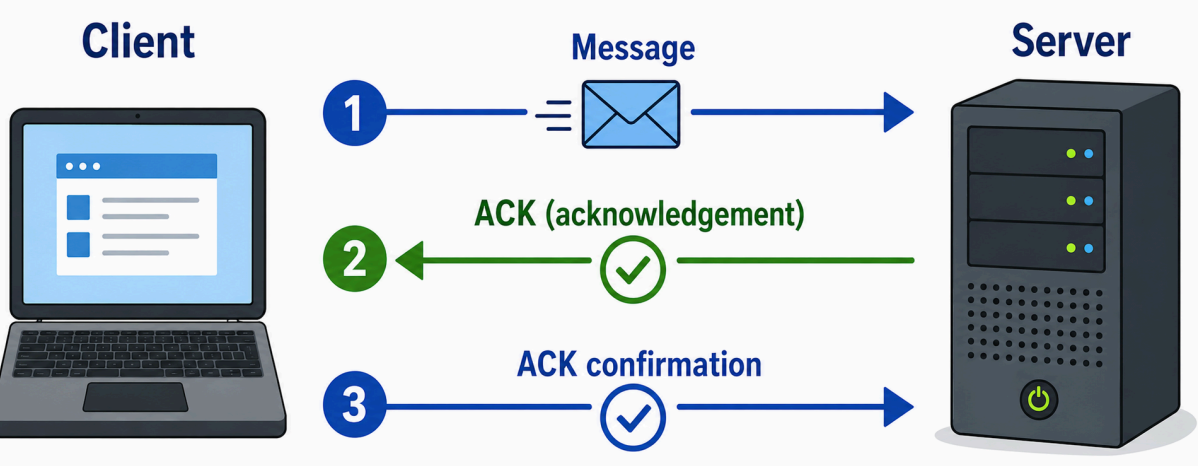
This reliability introduces overhead because ensuring reliability requires additional computational resources. In some situations, this may be undesirable, for example in a real-time application such as video streaming (Eggert et al., 2017; Schulzrinne et al., 2003).
Conversely, an unreliable service does not guarantee that specific data will actually reach its destination (Fairhurst et al., 2017; Postel, 1980).
Key points
Which Service Should Be Chosen?
A company is designing four functions for a new application:
For each function:
A Video Call with Network Problems
During a video call, some small audio fragments are lost.
The system designer must choose between two strategies:
Analyze the two solutions.
Transferring a File Without Errors
A student needs to upload a 2 GB project file to the cloud.
During the transfer, some packets are lost because of temporary network problems. However, the system must guarantee that the file received by the server is identical to the original.
Answer the following questions:
Designing a Location Tracking System
An application shows the real-time position of a bus on a map.
Every three seconds, the bus sends its current position:
The 10:00:03 update is lost during transmission.
The designer must decide whether to retransmit it or continue with the following updates.
To create these materials, I used generative artificial intelligence tools to support the writing process, particularly to improve the wording and style of the text, reorganize content, refine phrasing, and speed up certain editorial tasks.
Since I work independently on the production of these materials, I try to automate all activities that can reasonably be automated, so that I can devote more time to research, design, and content development.
However, artificial intelligence does not determine the content of the work: the selection of topics, structure, ideas, interpretations, examples, and teaching approach are developed by me. AI is therefore used primarily as a tool to support production and formal revision, while authorship and responsibility for the design and development of the content remain mine.
Unless otherwise stated, this material is licensed under the Creative Commons Attribution–NonCommercial–ShareAlike 4.0 International License (CC BY-NC-SA 4.0).
You are therefore free to share, redistribute, adapt, and create derivative works based on this material, provided that proper attribution is given, the material is not used for commercial purposes, and any modified or derivative versions are distributed under the same license.

Do you want to help me write articles like this one?


No responses yet