


The application layer, DNS, and domain names are the core concepts of this lesson, which focuses on the network architecture layer enabling programs and applications to communicate over the Internet.
The text introduces key application protocols—such as HTTP, SMTP, and FTP—and examines the workings of DNS, the system that translates human-readable domain names into the numerical addresses used by devices.
The lesson then explains the hierarchical structure of domains, distinguishing between TLDs, second-level domains, subdomains, and FQDNs.
Application layer
The application layer manages communications between the programs or applications running on users’ computers and the network itself.
This layer provides high-level services to applications, allowing them to communicate, exchange data, and interact with other applications across different networks.
At this layer, packets are called messages.
Some common protocols and services associated with the application layer include:
Domain
A very important application-layer service is the Domain Name System (DNS), which translates domain names into the addresses of hosts connected to the network (Mockapetris, 1987).
A domain is a unique, human-readable name used to identify and access online resources such as websites, email servers, online services, and more.
Domain names are read from right to left and consist of strings separated by dots.
Domains are mainly used to simplify access to Internet resources. Instead of remembering a sequence of numbers that identifies a server, users can enter a more meaningful domain name in a browser or application.
DNS therefore translates a domain name into a numerical address, allowing the network device to locate the corresponding host.
The DNS service is implemented through a globally distributed database made up of DNS servers Mockapetris, 1987).
DNS is similar to a phone’s contact list: when the number of
Mario Rossi is stored, there is no need to type his phone number; instead, you search the
contact list for the name Mario Rossi.
In the same way, the DNS service converts the domain
name (for example, esempio.it) into a number (for example, 190.12.13.54), which corresponds to the actual address of a specific host on the network. In the following chapters, we will see that this actual address is the IP address.
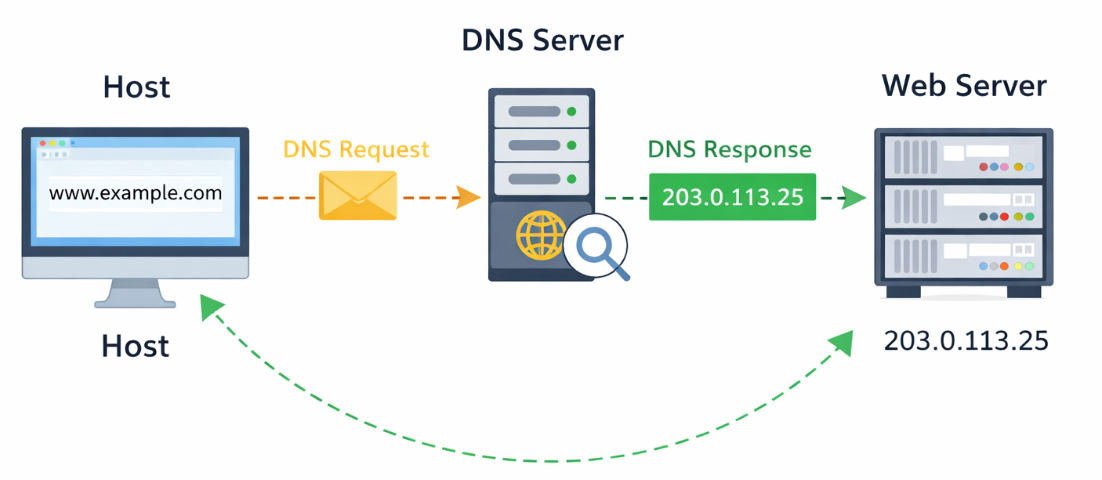
As soon as the user enters an address in the browser, the DNS server searches
its records for the corresponding numerical address.
If the address is not found, the DNS server forwards the request to another server that is more likely to have the required information. This process continues until an answer is found or it is confirmed that the name does not exist (Mockapetris, 1987).
A nameserver is an authoritative DNS server, meaning a server that directly stores the official information for one or more domainsi (Hoffman & Fujiwara, 2024).
Example
Suppose a user wants to access the web address “www.example.com.”
The user’s device sends a DNS request to a DNS server to obtain the actual address associated with this domain name.
The same domain name can be associated with multiple addresses.
This possibility can be used to:
When the client receives multiple addresses, it orders them according to specific criteria and attempts to establish a connection with one of them. If an attempt fails or takes too long, it can try another address.
Modern clients can start slightly staggered connection attempts toward different addresses and use whichever connection is established first.
This mechanism reduces waiting times when an address or network protocol is unreachable or particularly slow (Schinazi & Pauly, 2017).
Domain Hierarchy
A fully qualified domain name (FQDN) is a domain name specified in full, including every label in the DNS hierarchy, with no parts omitted (Hoffman & Fujiwara, 2024).
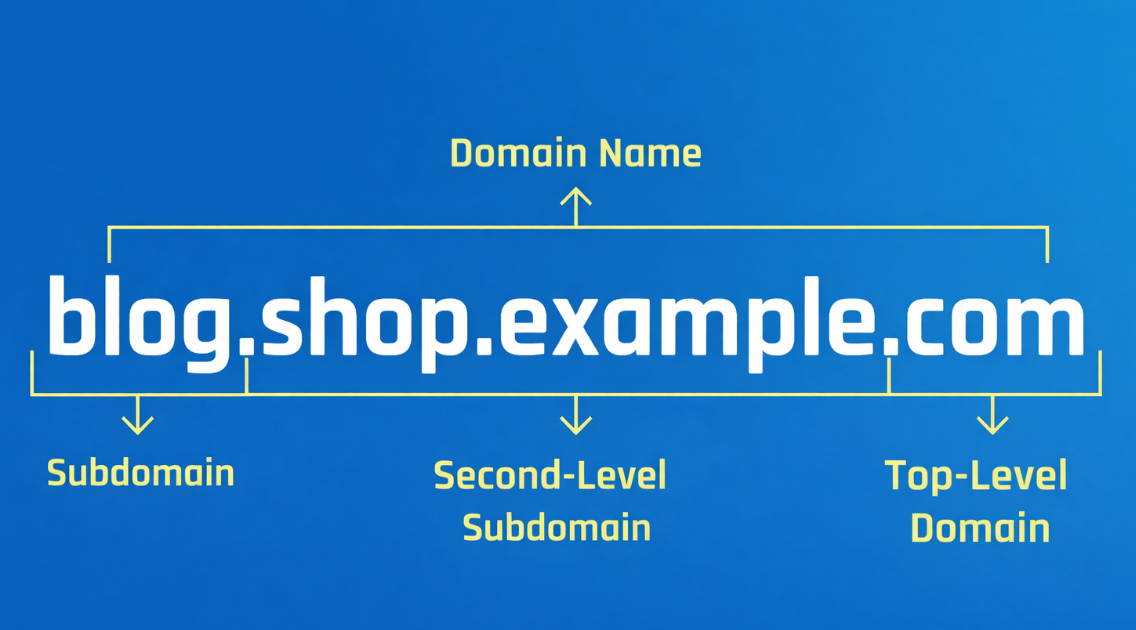
An FQDN is therefore an absolute name that identifies a resource precisely within DNS, all the way to the root.
A domain name is hierarchically organized into levels, read from right to left and separated by dots (Hoffman & Fujiwara, 2024).
The three main levels are:
Note:
A final dot (.) sometimes appears on the right. It represents the DNS root and makes the name complete and absolute. Without this dot, the name may be interpreted as relative in certain contexts (Hoffman & Fujiwara, 2024).
Top-Level Domain
In a domain name, the most important part is the first one from the right.
This is called the top-level domain, or TLD, for example “.org” or “.it.”
TLDs are managed and assigned by ICANN (Internet Corporation for Assigned Names and Numbers), the organization responsible for coordinating unique identification systems on the Internet (Internet Assigned Numbers Authority, n.d.).
There are two main types of TLDs:
Generic TLD
These TLDs are generally associated with broad categories rather than specific geographical locations.
Examples of generic TLDs include:
Country-Code TLD
These TLDs are associated with specific geographical locations or countries. Each country has its own TLD representing the domain’s geographical identity. Examples of country-code TLDs include:
Second-Level Domain
A second-level domain (SLD), often simply called the domain name, is the part of a domain name located immediately to the left of the top-level domain (TLD).
The domain name is the name chosen for a website, service, or online resource, following the format “SLD.TLD.” (Hoffman & Fujiwara, 2024).
For example, consider the domain “example.com”:
The second-level domain is what makes a domain name unique compared with others.
It is the customizable and identifying part of the web address.
It can consist of words or terms that reflect a brand, business activity, website content, or anything else the host wants to communicate.
The second-level domain and the top-level domain form the root domain or main domain, meaning the complete domain name without subdomains.
Subdomain
A subdomain is the part of a domain name located to the left of the second-level domain (Hoffman & Fujiwara, 2024).
Subdomains are mainly used to provide additional context, structure, and organization within the domain-name architecture.
A subdomain can itself consist of multiple levels, such as fourth-level, fifth-level, and so on.
Example
In the domain “materials.students.academy.us”:
In many cases, the leftmost part of the name may identify a specific host or service, such as www, mail, files, or db.
Examples include:
Example
The domain email.example.com indicates that the host we are connecting to provides the email service.
www.example.com indicates that the host we are connecting to serves a web page.
Registrar
A domain registrar is an organization or company authorized to facilitate the registration of Internet domain names (ICANN, 2023).
It acts as an intermediary between end users and domain-registration authorities.
The registrar provides domain registration, management, and renewal services, allowing users to establish an online identity through domain names.
To register a second-level domain, the user must request the service from a registrar.
Some key aspects of domain registrars are:
It is important to clarify that domain names are not sold; they are granted for temporary use.
When a user “buys” a domain, they are actually entering into a rental agreement: they obtain the exclusive right to use that name for a limited period, usually one or more years.
When the registration expires, the domain must be renewed. Otherwise, the right to use it ends and the name becomes available to other users. The registrar therefore does not sell property but manages a temporary right of use, while ultimate control of the domain remains within the global DNS governance system (ICANN, 2023).
Registry
After clarifying the registrar’s role, we must introduce the other key participant in the domain-name system: the registry.
A registry is the organization that officially manages a top-level domain (TLD), such as .it, .com, .org, .net, or .edu. (ICANN, n.d.).
While the registrar is the intermediary that interacts with the end user, the registry is the technical and administrative authority that maintains and governs the domain extension.
In simple terms:
The registry has three main responsibilities.
The first responsibility is to maintain the database of all domain names registered under a specific TLD.
This database contains essential information such as:
The second responsibility is to manage the TLD’s nameservers.
When a DNS service needs to resolve a name such as www.example.it, it first queries the root servers and is then directed to the TLD servers, in this case the “.it” servers.
These servers are managed by the registry and respond by identifying the authoritative nameservers for the requested domain (ICANN, n.d.).
The third responsibility is to define and enforce the domain’s rules.
Each TLD has its own policies defining who can register it, for how long, under what restrictions, and which renewal, transfer, or revocation procedures apply.
For example:
The registry does not sell domains directly to end users.
Instead, it operates through a network of accredited registrars authorized to interact with its database using standardized protocols.
When a user registers, renews, or transfers a domain:
In this model, the registry ensures global consistency, uniqueness, and reliability, while the registrar provides the commercial and operational interface for the user (ICANN, n.d.).
Key points
From the Website Name to the Server
A user types the following into the browser: www.example.com
The browser needs to reach the correct server, but the computer does not yet know its numerical address.
Answer the following questions:
Reading a Domain Name Correctly
Consider the following name:
materials.students.academy.us
Analyze it using the DNS hierarchy described in the learning material.
Registering a New Domain
A new association wants to use the domain: futureproject.org
The person in charge believes that it is enough to “buy the domain from the Internet” and that, once paid for, the name becomes the association’s permanent property.
Analyze the situation.
Designing the Names of an Online Service
A company owns the domain: creativecloud.it
It wants to organize several services:
Design a possible naming structure.
To create these materials, I used generative artificial intelligence tools to support the writing process, particularly to improve the wording and style of the text, reorganize content, refine phrasing, and speed up certain editorial tasks.
Since I work independently on the production of these materials, I try to automate all activities that can reasonably be automated, so that I can devote more time to research, design, and content development.
However, artificial intelligence does not determine the content of the work: the selection of topics, structure, ideas, interpretations, examples, and teaching approach are developed by me. AI is therefore used primarily as a tool to support production and formal revision, while authorship and responsibility for the design and development of the content remain mine.
Unless otherwise stated, this material is licensed under the Creative Commons Attribution–NonCommercial–ShareAlike 4.0 International License (CC BY-NC-SA 4.0).
You are therefore free to share, redistribute, adapt, and create derivative works based on this material, provided that proper attribution is given, the material is not used for commercial purposes, and any modified or derivative versions are distributed under the same license.
Do you want to help me write articles like this one?


No responses yet