


This lesson introduces the workings of a mobile network, explaining how smartphones, tablets, and other devices communicate via radio signals. It describes the role of the base transceiver station (BTS), which transmits and receives signals between mobile devices and the operator’s network.
The lesson then explains the concept of a “cell“—the geographic area covered by a base station—and clarifies why coverage varies depending on the operator, distance from the antenna, obstacles, frequencies used, and network congestion.
Finally, the lesson introduces roaming, frequency bands, and mobile standards such as 2G, 3G, 4G, and 5G, along with the key features of 5G: higher speeds, low latency, increased capacity, and support for advanced applications.
A mobile network is a wireless communication system that allows users of devices such as mobile phones, smartphones, tablets, and other mobile devices to connect with one another and with the rest of the world through radio signals (Kurose & Ross, 2026).
Mobile networks are built using a combination of communication infrastructures.
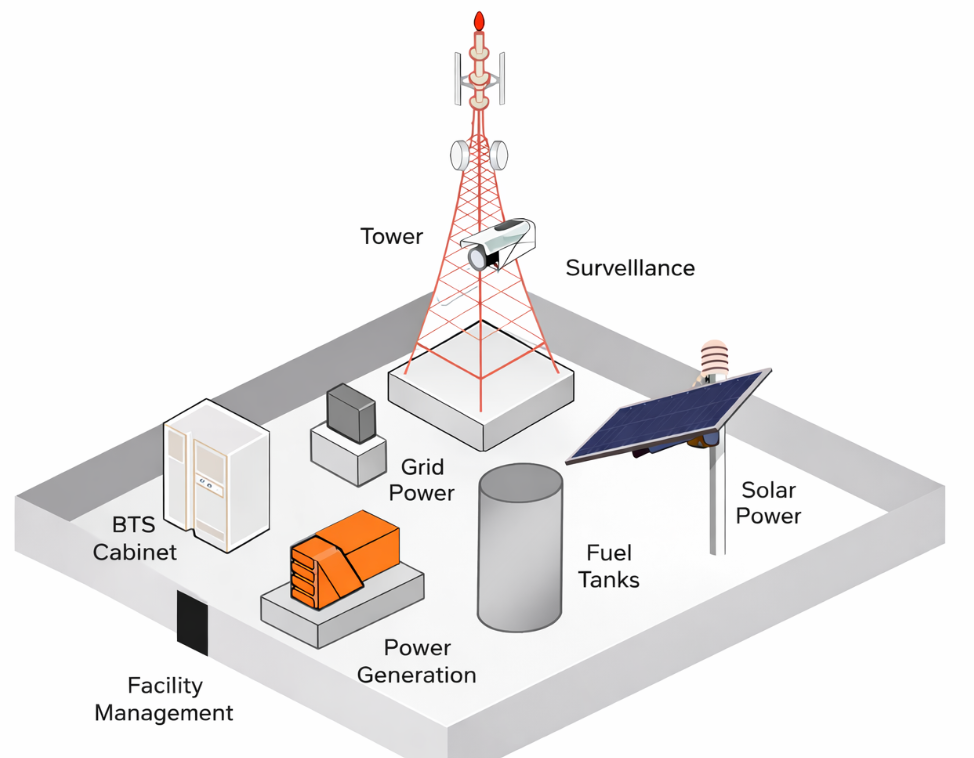
A key component of a mobile network is the base station (BS).
The BS includes the equipment that transmits and receives radio signals (3rd Generation Partnership Project [3GPP], 2022; Kurose & Ross, 2026).
Antennas can be installed on towers, masts, building rooftops, or other physical structures.
Mobile network
A mobile network is a wireless communication system that allows users of devices such as mobile phones, smartphones, tablets, and other mobile devices to connect with one another and with the rest of the world through radio signals (Kurose & Ross, 2026).
Mobile networks are built using a combination of communication infrastructures.
A key component of a mobile network is the base station (BS).
The BS includes the equipment that transmits and receives radio signals (3rd Generation Partnership Project [3GPP], 2022; Kurose & Ross, 2026).
Antennas can be installed on towers, masts, building rooftops, or other physical structures.
The following steps take place when a packet is sent from a device (3GPP, 2022; Kurose & Ross, 2026):
This infrastructure enables mobile users to make calls, send messages, browse the Internet, and use a variety of online services wherever mobile network coverage is available (Kurose & Ross, 2026).
But how does mobile coverage work?
The area covered by a mobile network is divided into regions called cells.
A cell is the geographical area served by a base station, which consists of equipment and antennas that communicate by radio with mobile devices in that area (3GPP, n.d.; Kurose & Ross, 2026).
It is important to distinguish between the tower and the network of an individual operator.
A tower is the physical structure on which the antennas and equipment of one or more mobile operators may be installed. However, not every operator is necessarily present on the same tower (Kurose & Ross, 2026).
For example, a tower may contain WindTre antennas and equipment but no Vodafone equipment. In the same area, a WindTre user might therefore have coverage, while a Vodafone user might have no coverage or a weaker signal because the device must connect to a more distant Vodafone cell (Kurose & Ross, 2026).
As a smartphone moves, it can gradually switch from one cell to another. This handover allows communication to continue while the user is moving, for example while walking, travelling by car, or riding on a train (3GPP, n.d.).
If no usable cell belonging to the user’s operator is available in a certain area, the smartphone searches for another cell from the same operator, even if it is farther away. If no usable cell can be found, the phone may show no service, although emergency calls may still be possible through available networks (European Commission, 2026).
In general, a device tends to connect to the cell from which it receives the best signal, which is often also one of the nearest cells.
However, the choice does not depend on distance alone: signal quality, physical obstacles, the frequencies used, network congestion, and the operator’s configuration also matter (3GPP, n.d., 2022).
The signal bars shown on a smartphone provide a simplified indication of the quality or strength of the radio connection to the mobile network. Mobile coverage therefore depends on the presence of towers in the area, the operators using those sites, the frequencies employed, physical obstacles, and the network configuration (3GPP, n.d.).
Each antenna operated by a service provider uses one or more radio-frequency bands, meaning specific ranges of frequencies, to transmit and receive signals (3GPP, 2022).
Radio-frequency bands are allocated and regulated by the relevant public authorities to prevent interference between services and operators.
Users’ devices must also support the specific frequency bands used by their operator; otherwise, they cannot connect to the network (3GPP, 2022).
Under normal conditions, a phone with a SIM from a particular operator connects to that operator’s network.
However, it can also connect to other networks when roaming agreements exist—that is, commercial and technical agreements between mobile operators—for example when the user is abroad or in certain special circumstances European Commission, 2026).
As a result, in the same geographical area, a Vodafone user might have better coverage than a TIM user if there are more Vodafone cells or if they are configured more effectively.
Internationally standardized rules and protocols are used so that mobile phones made by different manufacturers and transmitters operated by different providers can communicate reliably with one another (3GPP, 2022).
Mobile networks have evolved through several generations of standards, including 2G, 3G, 4G, and 5G.
At present, 5G is one of the most recent and advanced generations (3GPP, 2022).
The main characteristics of 5G include (3GPP, 2022; International Telecommunication Union, 2015):
5G can use different frequency bands: some are low or mid-band frequencies that provide wider coverage, while others are higher frequencies, such as millimeter waves, which can deliver high performance but over a more limited area (3GPP, 2022).
To compensate for these limitations, 5G requires a higher density of base stations, resulting in a larger number of more closely spaced cells to provide adequate coverage and high performance, including in urban areas (3GPP, n.d., 2022).
Key points
From a Smartphone to the Internet
Luca is outdoors and uses the mobile network to open a website on his smartphone.
Reconstruct the path followed by the data.
Two Phones, Two Different Coverage Levels
Anna and Marco are standing in the same place in the city.
Anna uses Operator A and her smartphone shows a very strong signal. Marco uses Operator B, but his phone shows only one signal bar.
A few hundred meters away, there is a tower with several antennas.
Analyze the situation.
Designing a Mobile Network for a City
A mobile operator wants to improve its network in a large city.
In the city center, many users are connected at the same time, using streaming services, online video games, IoT devices, and mobile devices while traveling by car or public transport.
The operator wants to make greater use of 5G and must decide how to organize the network.
Answer the following questions:
To create these materials, I used generative artificial intelligence tools to support the writing process, particularly to improve the wording and style of the text, reorganize content, refine phrasing, and speed up certain editorial tasks.
Since I work independently on the production of these materials, I try to automate all activities that can reasonably be automated, so that I can devote more time to research, design, and content development.
However, artificial intelligence does not determine the content of the work: the selection of topics, structure, ideas, interpretations, examples, and teaching approach are developed by me. AI is therefore used primarily as a tool to support production and formal revision, while authorship and responsibility for the design and development of the content remain mine.
Unless otherwise stated, this material is licensed under the Creative Commons Attribution–NonCommercial–ShareAlike 4.0 International License (CC BY-NC-SA 4.0).
You are therefore free to share, redistribute, adapt, and create derivative works based on this material, provided that proper attribution is given, the material is not used for commercial purposes, and any modified or derivative versions are distributed under the same license.

Do you want to help me write articles like this one?


No responses yet