


This lesson explains how an ISP network operates and what happens when a user connects to the Internet. The connection first passes through the operator’s network—using access technologies such as DSL, FTTC, or FTTH—and then enters the ISP network via a Point of Presence (POP).
It introduces fundamental concepts such as the last mile, backbone, peering, Internet Exchange Points, and IP transit, illustrating how operators exchange traffic and reach external networks.
Finally, the lesson describes the ISP hierarchy—Tier 1, Tier 2, and Tier 3—distinguishing between local operators, regional providers, and the major global backbones that interconnect the Internet on an international scale.
Architettura ISP
After examining what a WAN is and the role played by ISPs, we can take a closer look at what happens when a user connects to the Internet.
The connection is not made directly to the “entire Internet”. It first passes through the user’s operator network, which is connected to other networks in turn.
The image below shows what actually happens when a user connects to the Internet:

To connect to the Internet, a computer connects to an ISP, which enables it to exchange packets with all other hosts that can be reached through the Internet (Kurose & Ross, 2026).
Common methods for connecting to an ISP include telephone or copper lines, fiber-optic connections, mobile networks, and, in some cases, radio or satellite links (Kurose & Ross, 2026).
The following sections examine telephone lines and fiber-optic connections:
Telephone Line
DSL (Digital Subscriber Line) uses a telephone line to transmit digital data.
In a DSL connection, the computer is connected to a device called a DSL modem, which converts digital data into signals suitable for transmission over a twisted-pair telephone line.
At the other end, a device called a DSLAM (Digital Subscriber Line Access Multiplexer) receives these signals and passes them into the operator’s network (International Telecommunication Union [ITU], 1999; Kurose & Ross, 2026).
In practice, the home modem sends data through a copper twisted-pair telephone line. The line reaches a DSLAM, usually located in a telephone exchange or street cabinet. The DSLAM receives the lines of many subscribers simultaneously, keeps each subscriber’s traffic separate, and forwards it to the ISP’s network through a higher-capacity connection, often using fiber optics (Kurose & Ross, 2026).
This method is limited by the last mile of the connection.
In telecommunications, the term “last mile” refers to the section of cable connecting telephone exchanges to end users, namely the part of the telephone network known as the access network.
Connection performance decreases in this section because the last mile uses a much slower system—the telephone line—than the technology used within the ISP’s network, namely fiber optics (ITU, 1999; Kurose & Ross, 2026).
Fiber Optics
For faster Internet access, fiber-optic cables can be installed all the way to homes, since fiber optics is much faster than a telephone line (ITU, 2008; Kurose & Ross, 2026).
This is achieved through configurations called FTTH (Fiber to the Home) or FTTC (Fiber to the Cabinet). .
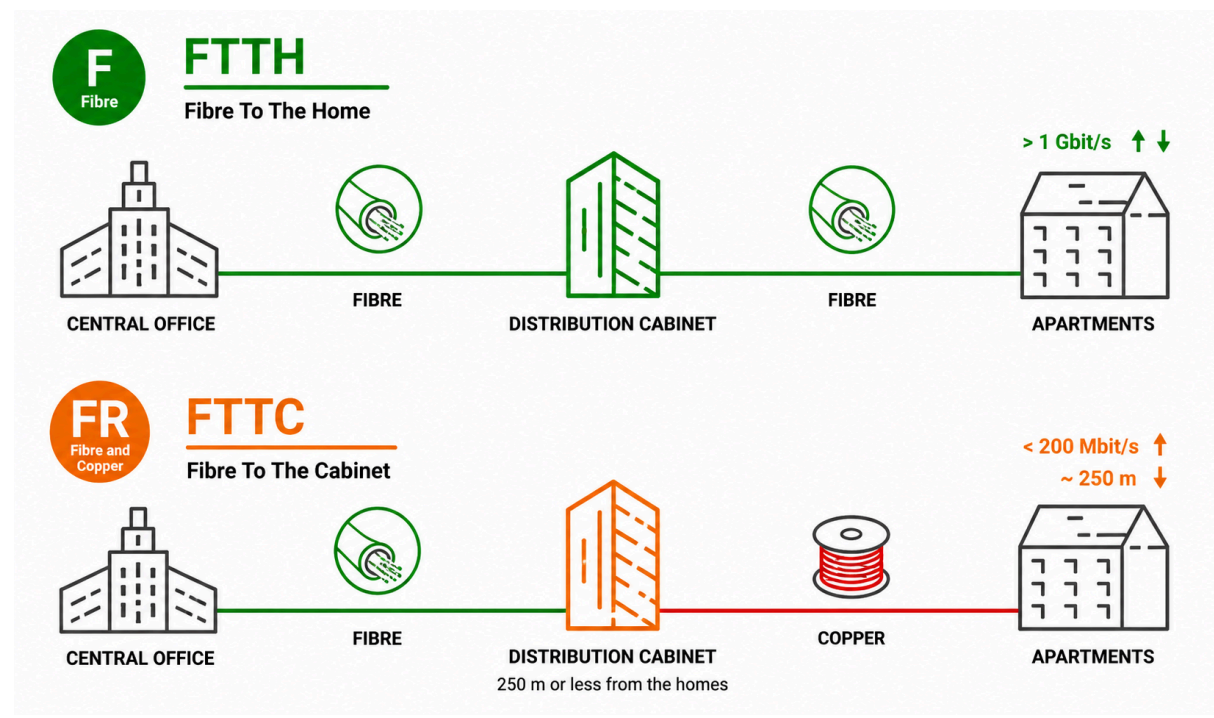
At this point, the data packets can be forwarded by the ISP (Kurose & Ross, 2026).
The point at which packets enter the ISP’s network is called a Point of Presence (POP).
ISP networks may operate at a regional, national, or international level.
The ISP’s backbone consists of long-distance transmission links that interconnect POPs in the different cities served by the ISP Kurose & Ross, 2026).
Example
Suppose you live in Palermo. Your ISP has a PoP in Palermo connected to its national backbone by fiber.
When you browse the Internet, your traffic enters the local PoP, where it is processed and then routed through the national or international network.
When a packet must reach a destination on the Internet, it may follow different routes (Kurose & Ross, 2026; Rekhter et al., 2006).
Many of these exchanges take place at Internet Exchange Points, or IXPs: physical locations where ISPs, corporate networks, and major content providers interconnect to exchange traffic more efficiently (Euro-IX, n.d.; Kurose & Ross, 2026).
Example
IXPs are not located everywhere. They are mainly found at major strategic connection hubs: cities with extensive network infrastructure through which national and international operators pass.
In practice, an IXP is a “marketplace” where ISPs, corporate networks, and content providers such as Google, Meta, and Netflix exchange traffic to reduce costs and latency—the delay before data reaches its destination.
Italy has several Internet Exchange Points, including MIX in Milan, NaMeX in Rome, and TOP-IX in Turin (MIX, n.d.; NaMeX, n.d.; TOP-IX, n.d.).
When an ISP cannot reach a destination through its own connections or peering agreements, it can purchase IP transit from another operator called a transit provider.
A transit provider is an ISP that sells connectivity to other ISPs or customers. It allows data traffic to be routed through its network to reach destinations that the customer’s network could not otherwise access directly (CAIDA, n.d.; Kurose & Ross, 2026).
This gives the customer organization access to the Internet without requiring it to negotiate peering agreements with many different networks.
The connectivity provided by a transit provider is called IP transit.
ISP Hierarchies
Now that we understand how an individual ISP works, we can examine the overall structure.
Not all ISPs are the same. They have different levels of coverage, independence, and decision-making power, creating a logical and commercial hierarchy.
This structure forms an ISP hierarchy divided into levels called tiers (CAIDA, n.d.; Kurose & Ross, 2026).
Understanding this hierarchy is essential for explaining how the Internet works on a global scale, who operates its infrastructure, and how data travels from one side of the world to the other.
The ISP hierarchy is divided into three main levels:
Tier 3 – Local or Retail ISPs
Tier 3 ISPs are the providers closest to end users.
Example
Tier 3 providers may be small local operators, wireless providers serving mountainous areas, or regional operators in underserved locations.
Tier 2 – Regional Providers
Tier 2 ISPs are intermediate providers: they operate their own networks but cannot reach the entire Internet independently.
Example
An individual user normally connects through a Tier 2 ISP.
Suppose you live in Milan or Palermo and have a home Internet connection provided by Fastweb, Vodafone, or WindTre.
These operators have their own national networks, regional backbones, peering connections with other providers, and data centers.
However, they do not operate an independent global network, so they must purchase transit from Tier 1 providers to reach other countries or continents. They are therefore classified as Tier 2 ISPs.
As a user, you therefore connect to a Tier 2 ISP, which relies on Tier 1 ISPs to reach the rest of the world.
A Tier 2 ISP may act as a transit provider for other Tier 2 ISPs for several reasons:
Example
A Tier 2 provider with a strong network in Europe could supply transit to another Tier 2 provider that needs efficient access to that region, even if the second provider is already connected to a Tier 1 network.
Specific example:
Tier 1 – Global Backbone Operators
At the top of the hierarchy are large international backbones containing thousands of routers connected by fiber-optic links.
These ISPs, known as Tier 1 providers, do not pay for transit and operate international backbones that carry global traffic between continents through submarine cables crossing the oceans.
A Tier 1 operator can reach every network on the Internet without purchasing IP transit, thanks to its own connections and peering agreements with other Tier 1 providers.
In practice, Tier 1 providers play a fundamental role in connecting major networks and continents.
A Tier 1 ISP has peering agreements with all other Tier 1 providers. This means they exchange traffic without paying one another, based on a balanced and reciprocal exchange of data (CAIDA, n.d.; Kurose & Ross, 2026).
Key points
From the Computer to the ISP Network
Marco uses a DSL connection. His computer sends a request to a website on the Internet.
The home connection uses a telephone copper pair and, in Marco’s area, users’ lines reach a DSLAM installed in a street cabinet.
Answer the following questions:
FTTC or FTTH?
Two families live in the same neighborhood.
Compare the two solutions.
From the POP to the Backbone
A user living in Palermo uses a national ISP. Their traffic enters the operator’s network through a POP in Palermo.
The ISP also has POPs in Rome, Milan, and Turin, connected through its national backbone.
Analyze the situation.
Two ISPs Need to Exchange Traffic
ISP A and ISP B have many customers who frequently communicate with one another.
At present, traffic between the two networks follows an indirect path. The two operators are considering connecting directly at an Internet Exchange Point.
Answer the following questions:
When Peering Is Not Enough
A small ISP can directly reach some networks through peering agreements, but it does not have enough connections to reach every destination on the Internet.
The operator therefore decides to purchase a service from a larger ISP.
Analyze the solution.
Reconstructing the ISP Hierarchy
Consider three operators:
Analyze the three cases.
To create these materials, I used generative artificial intelligence tools to support the writing process, particularly to improve the wording and style of the text, reorganize content, refine phrasing, and speed up certain editorial tasks.
Since I work independently on the production of these materials, I try to automate all activities that can reasonably be automated, so that I can devote more time to research, design, and content development.
However, artificial intelligence does not determine the content of the work: the selection of topics, structure, ideas, interpretations, examples, and teaching approach are developed by me. AI is therefore used primarily as a tool to support production and formal revision, while authorship and responsibility for the design and development of the content remain mine.
Unless otherwise stated, this material is licensed under the Creative Commons Attribution–NonCommercial–ShareAlike 4.0 International License (CC BY-NC-SA 4.0).
You are therefore free to share, redistribute, adapt, and create derivative works based on this material, provided that proper attribution is given, the material is not used for commercial purposes, and any modified or derivative versions are distributed under the same license.

Do you want to help me write articles like this one?


No responses yet