


How does data travel across networks?
This lesson explains the primary methods by which data is transmitted within networks.
It begins by presenting circuit switching—typical of traditional telephony—where a dedicated path between the two parties is reserved before data exchange begins. Next, it introduces packet switching—used by the Internet—where information is broken down into packets that can follow different paths across the network before being reassembled at the destination.
The lesson compares the two models, highlighting the efficiency of packet switching alongside the potential for variable delays. Finally, it describes the main types of transmission channels: point-to-point (or unicast) links and broadcast networks, where the channel is shared by all machines on the network.
Communication modes in networks
After examining the main physical devices in a network, we can consider how data is actually transmitted.
Networks can use different communication methods, meaning different ways of connecting devices and transmitting information (Kurose & Ross, 2026; Tanenbaum et al., 2021).
Circuit switching
Circuit switching is typically associated with connection-oriented communication because a dedicated path is established before data is exchanged. This occurs, for example, in telephone communication, where a temporary circuit connects the two callers through a series of connections from one telephone exchange to the next (Kurose & Ross, 2026; Tanenbaum et al., 2021).
The transmission resources, such as telephone equipment, lines, and portions of telephone exchanges, remain allocated to the two callers until the call ends (Kurose & Ross, 2026).
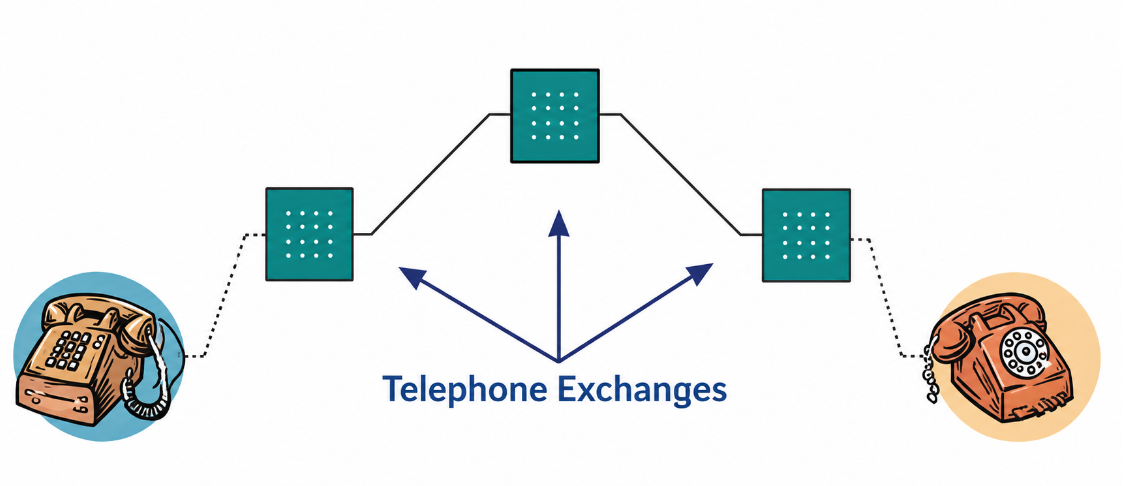
Connection-oriented services use transmission resources inefficiently because, when the two callers are not transmitting any signal—for example, when they are silent—the reserved resources remain unused (Kurose & Ross, 2026).
Example
Suppose there are two telephones, one in city A and the other in city B, and we want to establish a direct telephone call between them using circuit switching:
Packet switching
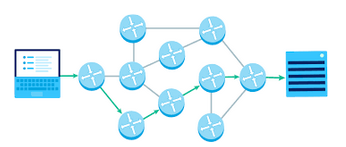
Packet switching can operate without establishing a dedicated path in advance: packets are entrusted to the network and may follow different routes (Kurose & Ross, 2026; Tanenbaum et al., 2021).
The information to be sent is divided into data packets and passed to the network together with the recipient’s address, much like items sent through the postal system.
The network is responsible for carrying and routing each packet to its destination.
Unlike circuit switching, packet switching:
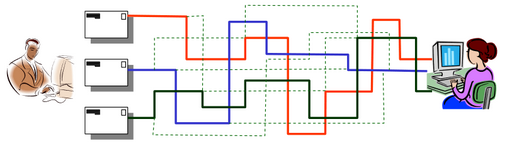
Packet switching is highly flexible and efficient, but it can introduce variable delays (Kurose & Ross, 2026).
For this reason, real-time applications such as Internet calls, video conferences, and online games require specific protocols and techniques to reduce delays and interruptions (Kurose & Ross, 2026).
For example, when receiving a file or an email, the user may not notice a delay. In a real-time event such as a telephone call, however, even a one-second delay is noticeable to both participants.
The Internet uses packet switching: data is divided into packets and forwarded through the network. Some protocols add controls to manage packet order, errors, and reliability (Kurose & Ross, 2026; Postel, 1981).
Example
Suppose you want to send an email containing a text message and several images to a friend. Using packet switching, the process might work as follows:
Types of Transmission Channels
Two types of transmission channels are widely used:
Point-to-point connections, also called unicast connections, connect pairs of computers (Tanenbaum et al., 2021).
In a network made up of point-to-point connections, packets may have to pass through one or more intermediate machines to travel from the source to the destination.
Individual point-to-point connections are called links.
In its most basic sense, a link is a direct communication line between two nodes.
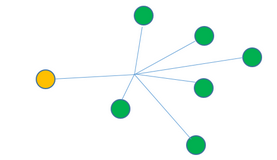
By contrast, a broadcast network has a single communication channel shared by all the machines in the network: packets sent by any machine are received by every machine on the network (Tanenbaum et al., 2021).
When a message is received, each machine checks its address field. If the address matches that machine, the message is processed; otherwise, it is ignored (Tanenbaum et al., 2021).
Key points
A Line That Is Always Reserved
Two company offices need to communicate for one hour. Before communication begins, the system establishes a dedicated path between the two offices and keeps the necessary resources reserved until the end of the session.
During the hour-long connection, however, no data is transmitted for several minutes.
Answer the following questions:
Ten Users Have to Share the Same Network
A network is used simultaneously by ten users. Each user transmits data only for short periods and remains inactive most of the time.
Two solutions are proposed:
Analyze the two solutions.
A Message Travels Across the Internet
You need to send a friend an email containing text and some images. The message is transmitted across the Internet using packet switching.
Reconstruct what happens.
Download and Videoconference
A student is simultaneously:
In both cases, the data travels through a packet-switched network. At a certain point, the network becomes congested and some packets experience variable delays.
Answer the following questions:
Reconstructing a Point-to-Point Path
Computer A needs to send data to Server B. The two devices are not directly connected, but several intermediate devices exist between them.
The path followed is:
Computer A → Router 1 → Router 2 → Router 3 → Server B
Analyze the communication.
A Message for Everyone, but Intended for Only One Device
In a small network, a single communication channel is shared by all devices.
Computer A sends a packet intended for Computer D. Computers B, C, and E also receive the packet through the shared channel.
Answer the following questions:
Another student states: “If everyone receives the packet, then everyone must necessarily process its contents.”
Evaluate the statement and explain the error using the operation of broadcast networks described in the learning material.
To create these materials, I used generative artificial intelligence tools to support the writing process, particularly to improve the wording and style of the text, reorganize content, refine phrasing, and speed up certain editorial tasks.
Since I work independently on the production of these materials, I try to automate all activities that can reasonably be automated, so that I can devote more time to research, design, and content development.
However, artificial intelligence does not determine the content of the work: the selection of topics, structure, ideas, interpretations, examples, and teaching approach are developed by me. AI is therefore used primarily as a tool to support production and formal revision, while authorship and responsibility for the design and development of the content remain mine.
Unless otherwise stated, this material is licensed under the Creative Commons Attribution–NonCommercial–ShareAlike 4.0 International License (CC BY-NC-SA 4.0).
You are therefore free to share, redistribute, adapt, and create derivative works based on this material, provided that proper attribution is given, the material is not used for commercial purposes, and any modified or derivative versions are distributed under the same license.

Do you want to help me write articles like this one?


No responses yet